How Google Is Quietly Rewiring Your Memory
Saturday, June 14, 2025
Digital Amnesia: Google Is Changing How We Remember
What if your memory wasn’t fading because of age…but because of your phone?
That’s the stunning idea behind a phenomenon researchers call the “Google Effect” - also known as digital amnesia.
It’s not just theory. A landmark study by Columbia University psychologist Betsy Sparrow and colleagues revealed something strange about our modern minds: We remember where to find information better than the information itself.
It’s not Alzheimer’s.
It’s adaptation.
But while this shift may help us navigate a fast-paced, info-overloaded world - it could also be quietly eroding our deeper thinking, memory strength, and independence.
Let’s unpack how it works and what to do about it..
Read the full "Google Effect Study Here
Forget the Details - Remember the Digital Location
In the pivotal Columbia study, participants were asked to memorize trivia facts. Some were told the information would be saved on a computer; others were told it would be erased.
Here’s what happened:
Those who believed the info was saved didn’t remember it.
But they did remember exactly where it was stored.
This is the essence of digital amnesia: we assume knowledge is always accessible, so our brains skip the step of storing it.
Why this matters:
This changes how we think. Instead of encoding facts, we encode locations. We’re not training our memory - we’re training our bookmarks.
And when devices fail, or we're caught without them, so does our ability to recall even basic facts.
Try this at home: Next time you search for a recipe, turn off your device and cook from memory. It might be messy - but it gives your brain a workout.
Google Is Convenient, But At What Cost?
In a recent survey by Kaspersky Lab, 91% of adults admit using digital devices as memory aids, and nearly half say they rely on phones to remember important details like birthdays or appointments.
What’s worse?
30% forget a fact the moment they close the tab.
Many can’t recall their own phone number without checking.
Our brains, once designed to store deep networks of knowledge, are slowly being trained to “just Google it.”
And while that works for trivia, it’s risky when it comes to managing medications, remembering financial details, or holding meaningful conversations without notes.
Daily tip: Keep a small paper journal of “things I learned today.” Don’t Google. Write it down. Let your brain build its own search engine.
Transactive Memory: Why We Think in Teams (and Tech)
The Google Effect builds on an older concept called transactive memory - the idea that groups share cognitive load.
You might not know your daughter’s birthday because your spouse always remembers it. Or you rely on your accountant for financial numbers.
Now, the team we “think with” includes Google, Siri, and chatbots like me.
This is efficient… until it isn’t.
The risk? When the “team” isn’t available (you lose internet, your phone dies), your brain finds itself untrained and unprepared.
Relying too much on digital tools may chip away at your ability to store critical information - like where you parked the car, or your new doctor’s name.
Memory tip: Try going one full hour a day without any digital assistance. No phone lookups. No calendar apps. Just you, your thoughts, and your own recall.
Cognitive Trade-Off: Convenience vs Deep Thinking
We often think of memory like a computer - more storage is better.
But in reality, memory is selective. Your brain chooses what’s worth keeping.
In the Google age, what we’re signaling is this: “Don’t bother storing it, I’ll just look it up.”
That shift saves energy, but it can weaken two major brain processes:
Deep Encoding: When you re-read, write, or reflect on something, it sticks.
Meaningful Association: Linking new info to what you already know makes recall faster and stronger.
But the digital shortcut bypasses both. It gives you fast answers without forcing any real thinking. That may be fine for weather forecasts. But not for names, dates, medications, or stories that matter to your life.
Practice boost: Instead of saving every article, try summarizing it aloud to yourself—or someone else. This forces encoding and builds stronger mental roots
Final Thoughts
We often blame memory loss on age, genetics, or stress. But sometimes, the real culprit is hiding in plain sight - inside our pockets.
The Google Effect is real. But it’s also reversible. You can still build a strong, resilient, independent memory, if you balance convenience with intentional cognitive effort.
Your brain doesn’t need perfect recall, it just needs practice.
Alex Rowen,
Published June 14th, 2025
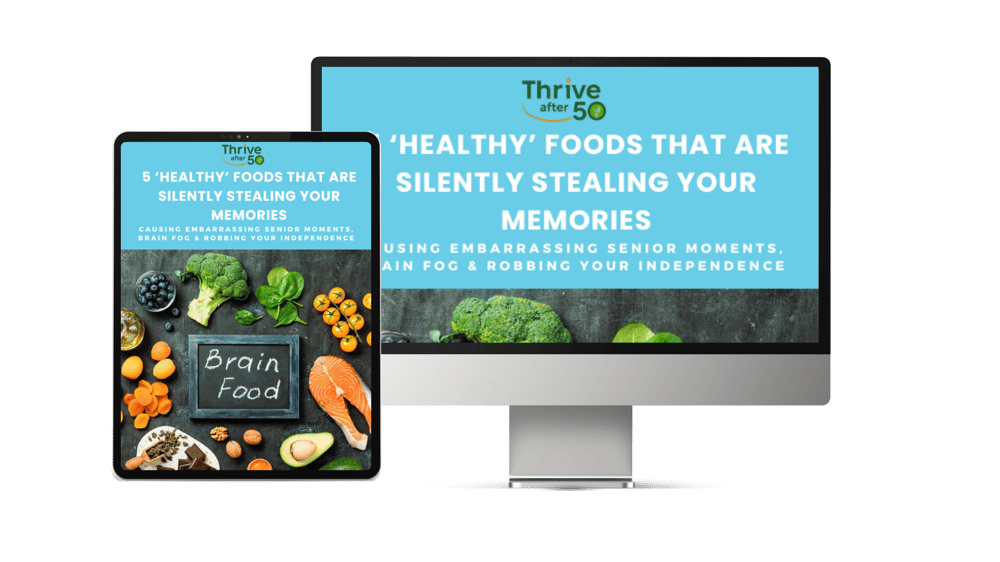
5 'Healthy' Foods That Are Silently Stealing Your Precious Memories
You’ve been eating these for years… not knowing they could shrink your brain. But now, neurologists are warning they may actually speed up memory loss.
If you want to stop those scary senior moments and forgetfulness STOP eating these 5 foods TODAY!
Enter your email below to discover the 5 worst 'healthy' foods that are causing brain fog, forgetfulness and embarrassing senior moments
Please Make Sure Your Email Is Correct
This report, valued at $19.95, is 100% FREE. No credit card required. You'll also receive our free fit tips e-newsletter from Thrive After 50. Your information is 100% secure and will never be shared with anyone.